

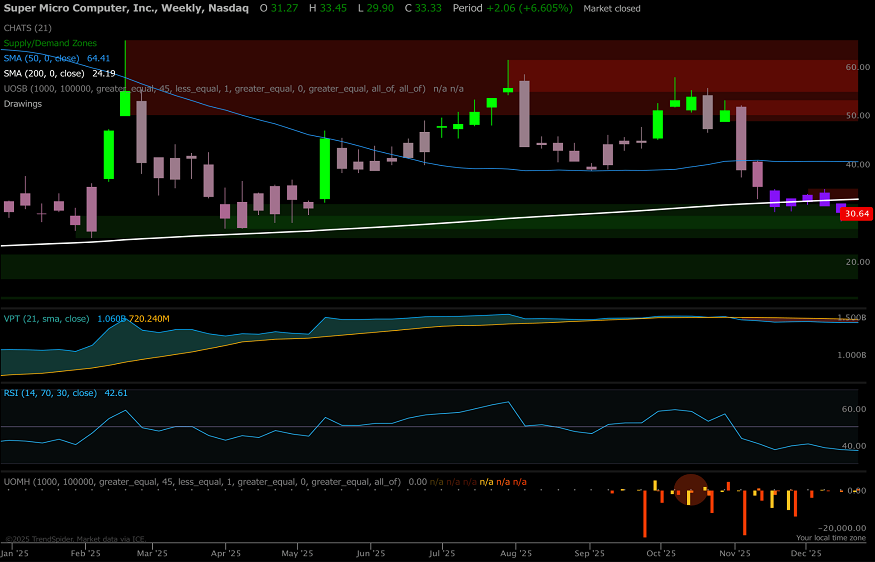
Artificial intelligence is reshaping the global data centre industry at an extraordinary pace. As businesses deploy increasingly sophisticated AI models, demand is rising for powerful servers, advanced networking, high-density computing systems, and more efficient cooling technologies. This expansion is creating opportunities not only for semiconductor manufacturers but also for the companies responsible for building the infrastructure that allows those chips to operate at scale.
Super Micro Computer has established itself as an important participant in this infrastructure market. The company develops servers, storage systems, rack-scale solutions, and complete data centre infrastructure designed for demanding computing workloads. Its recent financial growth highlights the strength of AI-related demand, but rapid expansion alone does not determine whether a company can deliver sustainable value to shareholders.
AI Infrastructure Demand Creates a Large Opportunity
The expansion of artificial intelligence is one of the most important factors supporting Super Micro Computer’s growth prospects. Training and operating advanced AI models requires substantial computing capacity, and businesses are continuing to invest in data centres capable of supporting increasingly demanding workloads. This creates demand for specialised servers and integrated infrastructure that can handle high-performance accelerators.
Read More : Trading Strategies: Navigating the Top Losers
Supermicro’s business is positioned across several parts of this infrastructure chain. Rather than concentrating exclusively on individual server components, the company provides systems that can combine computing, networking, storage, power management, and cooling. This broader approach can be valuable to customers looking for integrated solutions that can be deployed efficiently within modern data centres.
Cooling is becoming particularly important as computing density increases. High-performance AI systems generate significant amounts of heat, creating challenges for traditional air-cooling approaches. Direct liquid cooling offers an alternative for managing thermal loads in dense computing environments, while potentially helping data centre operators address energy-efficiency requirements. Supermicro’s investment in this area gives it exposure to an infrastructure trend that could become increasingly important as AI deployments expand.
Growth Must Be Balanced Against Margin Pressure
Revenue growth is an obvious measure of success, but it does not tell the entire story for a hardware-focused company. Supermicro has experienced substantial increases in sales as AI infrastructure spending has accelerated. However, investors also need to examine how much of that additional revenue becomes gross profit, operating income, and ultimately free cash flow.
Hardware markets can be particularly sensitive to pricing pressure. Large customers purchasing systems at scale often have considerable negotiating power, while competitors may reduce prices to win contracts. Component costs can also fluctuate significantly depending on supply and demand.
This makes gross-margin performance an important indicator for the company. Investors should watch whether higher-value rack-scale systems and integrated infrastructure solutions can support stronger margins over time. If the company can increase profitability while maintaining rapid sales growth, earnings could potentially expand at an attractive pace. If competitive pressure limits pricing power, however, increasing revenue may produce less incremental profit than expected.
Competitive Pressure Shapes the Investment Case
The AI infrastructure market includes numerous established technology companies and specialised manufacturers. Supermicro competes with large server providers, original design manufacturers, networking companies, and other infrastructure specialists. These competitors can have substantial manufacturing resources, established enterprise relationships, and global distribution networks.
For Supermicro, speed and flexibility are important competitive considerations. The AI hardware market changes quickly as new processors, accelerators, networking technologies, and cooling systems become available. Companies that can design and deliver systems around new technologies quickly may be able to capture demand from customers seeking to deploy the latest computing platforms.
This is where investors examining Super Micro Computer stock should look beyond headline revenue growth. Research and development spending, production efficiency, and product innovation therefore deserve attention alongside financial results.
Valuation Requires More Than a Single Multiple
Rapidly growing technology companies can be difficult to value because their future earnings may look very different from their current earnings. Applying a single price-to-earnings or price-to-sales multiple without considering future business conditions can create an incomplete picture.
An investor may reach very different conclusions depending on whether future revenue growth remains exceptionally high, moderates gradually, or experiences a more significant slowdown.
Margins are particularly important to this calculation. A company generating billions of dollars in additional revenue can have a very different valuation profile if its operating margins expand compared with one where margins remain under constant competitive pressure. Investors should therefore consider multiple scenarios rather than relying on one optimistic or pessimistic forecast.
Conclusion
Super Micro Computer operates in one of the most closely watched segments of the technology industry. The continued development of artificial intelligence is driving demand for increasingly powerful and sophisticated data centre infrastructure, creating a significant market opportunity for companies capable of delivering these systems efficiently.
Read More : A Comprehensive Guide: Data-Driven Insights for
However, the company’s future performance will depend on more than the growth of AI spending. Investors should pay close attention to margins, competitive pricing, supply-chain execution, customer concentration, capital requirements, and cash flow.